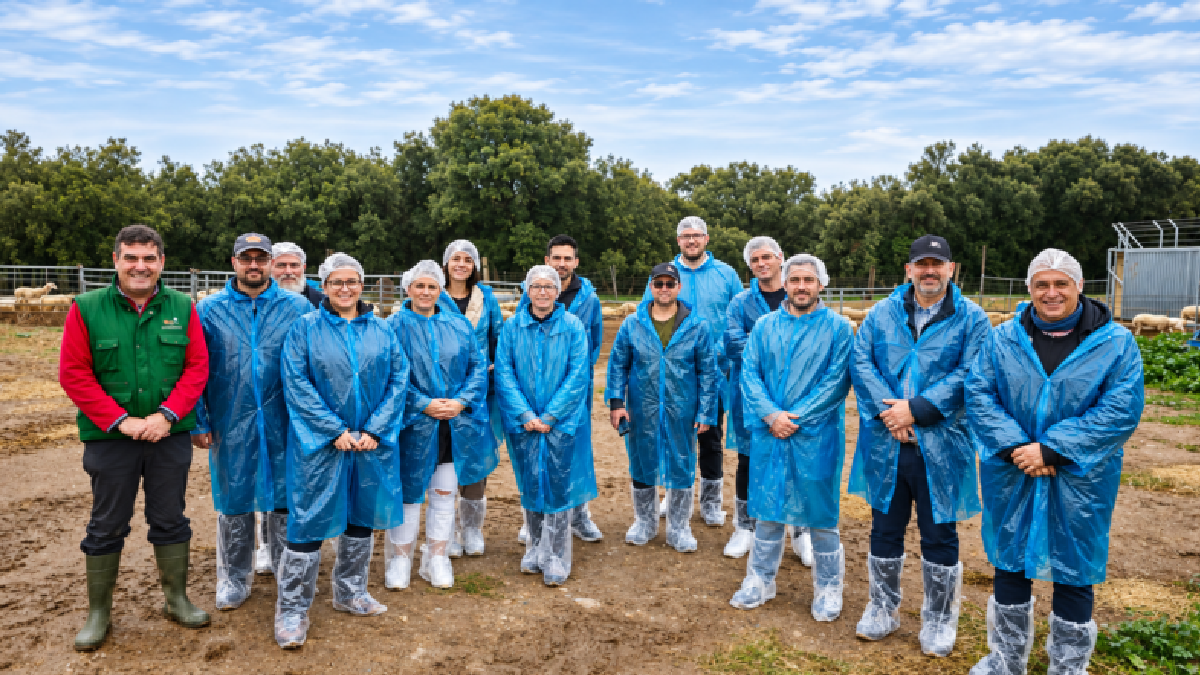
INTEROVIC hosted a delegation of twelve professionals representing Hungary’s leading sheep producers and marketers last week, as part of a technical mission designed to examine the operations and core strengths of the Spanish ovine sector firsthand.
Held from November 9 to 13 across Aragon and Catalonia, the visit featured meetings with cooperatives, meat processors, and livestock farmers to exchange expertise on sheep meat production, innovation, processing, and marketing.
From the cooperative model to innovation and marketing
A key highlight of the itinerary was a visit to the Pastores Cooperative Group in Zaragoza, where the Hungarian delegation explored its vertically integrated production and marketing structure, alongside the role of the PGI Ternasco de Aragón label in product differentiation and value creation.
The tour also included stops at livestock farms and feedlots to observe Spanish husbandry systems, as well as meetings with meat industry companies such as Carns Jove to analyze processing workflows and commercial strategies. Additionally, the delegation visited a facility processing sheep wool into thermal insulation for the construction sector—highlighting circular-economy opportunities to valorize industry by-products.
Gastronomy played a central role throughout the program, featuring tastings and showcases dedicated to Ternasco de Aragón and El Paquito, the signature lamb sandwich promoted by INTEROVIC to introduce lamb to younger demographics and casual dining occasions.
Spain and Hungary strengthen bilateral sector collaboration
The reverse trade mission served to deepen commercial and professional ties between Spain and Hungary, facilitating the exchange of best practices and identifying new areas for cooperation amid shared challenges across the European sheep sector.
The initiative forms part of the European promotional campaign “Celebrate the everyday with lamb” (2025–2027), which runs jointly in Spain and Hungary to boost awareness and consumption of European suckling lamb, lamb, and kid meat—emphasizing their quality, traceability, sustainability, and regional heritage.