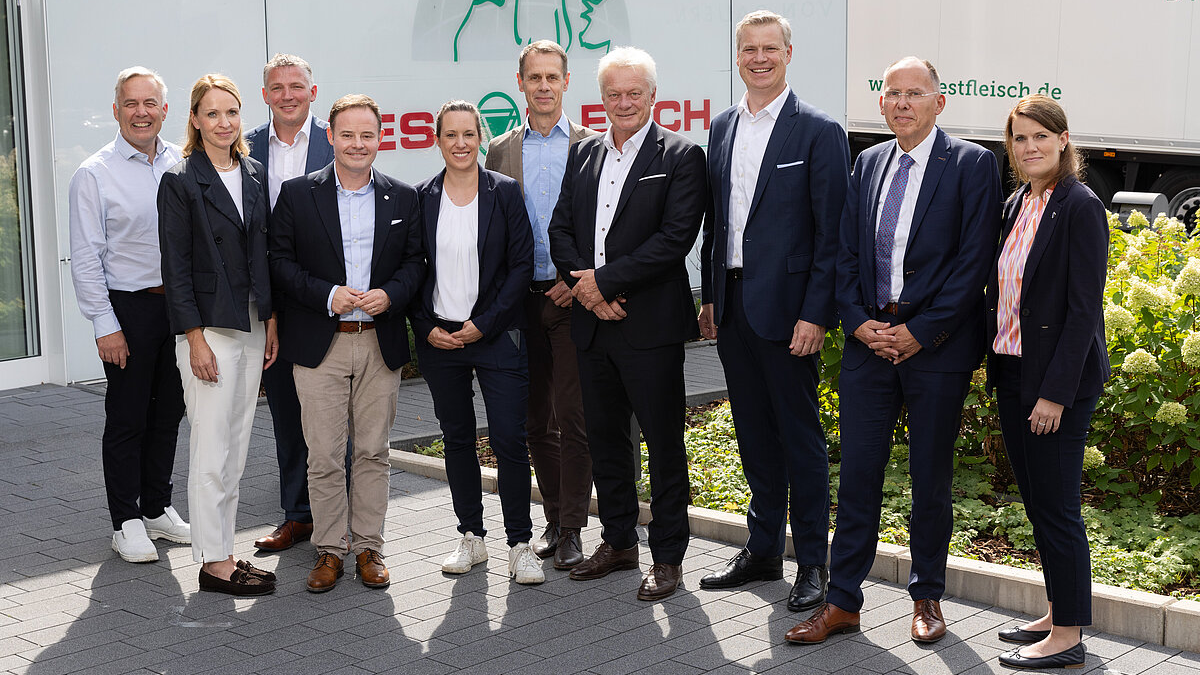
Federal Agriculture Minister Alois Rainer visited the Westfleisch site in Oer-Erkenschwick to learn about the use of artificial intelligence (AI) in official meat inspection. The focus of the visit was on technical discussions with Westfleisch representatives and a tour of the “ArtificialVet” pilot project.
The meeting was attended by Westfleisch representatives: Supervisory Board Chairman Jochen Westermann, Board Member Michael Schulze Kalthoff and Dr. Anne Hiller, Head of Group Quality Management.
Minister Rainer gained firsthand insight into the practical application of the AI-supported system. Since December 2025, “ArtificialVet” has been supporting official veterinary examiners with digital preliminary findings as part of a pilot phase.
AI as the “digital eye” of meat inspection:
At the heart of the system is a unit with six high-performance cameras that capture the entire pig carcass. An AI analyzes the images and detects, among other things, changes to the ears and tail, as well as growths.
The system is based on thousands of sample images evaluated by experts. However, official veterinarians always set the professional standard and continue to make the final diagnosis. The AI serves solely as an additional support tool.
The nationwide unique project of its kind
, “ArtificialVet,” is a joint development of Westfleisch, CIMT AG, an internationally active IT consulting specialist for digital transformation projects headquartered in Hamburg, and the veterinary office of the Recklinghausen district. The project is the first of its kind in Germany.
Industry, government agencies, and academia are working closely together to develop and validate the system. Since April 2026, the University of Leipzig has been providing scientific support for the project as part of a doctoral dissertation.
“Our goal is to develop an additional component for official meat inspection through the use of AI. Close cooperation with authorities and science is an essential prerequisite for this,” says Dr. Anne Hiller, Head of Group Quality Management at Westfleisch.
The visit of Federal Agriculture Minister Alois Rainer provided an opportunity to demonstrate the practical application of “ArtificialVet” and to discuss the potential of digital technologies for the further development of official meat inspection.
With the pilot project in Oer-Erkenschwick, Westfleisch is gathering important insights for assessing the opportunities and limitations of AI-supported methods in meat inspection for the entire industry. These experiences are intended to support the further development and classification of the technology.
ASF prevention and market opening remain in focus.
In addition to the use of AI, other current topics in the meat industry were the focus of the exchange with Federal Agriculture Minister Alois Rainer.
Westfleisch representatives discussed the prevention of and response to African swine fever (ASF). In particular, Westfleisch addressed the industry’s requirements in the event of an outbreak in a domestic pig herd, as well as the importance of early preparation and clear procedures in case of an emergency.
The prospects for opening the Chinese market to German pork products were also discussed. All participants particularly praised the support provided by the Federal Ministry of Food, Agriculture and Consumer Protection (BMEL). Both parties emphasized that joint efforts to open the Chinese market should be further pursued.