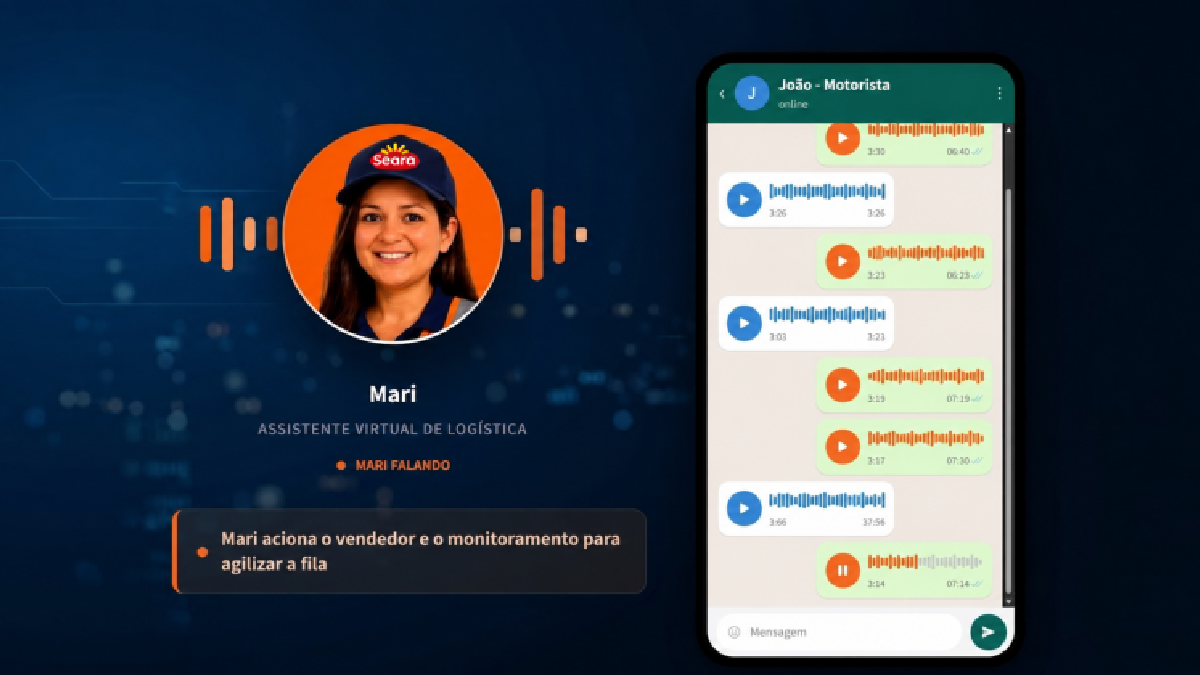
A virtual assistant monitors operations in real time, connects drivers and support areas, and integrates the company’s strategy to increase delivery effectiveness to 98.5%.
Seara, a JBS subsidiary, now uses an artificial intelligence assistant that works directly on the delivery route to address one of the main challenges in food distribution: monitoring a large-scale operation in real time and quickly transforming route information into decisions. The new technology cross-references operational data and connects drivers, sales teams, and support areas during deliveries, aiming to increase efficiency and raise delivery effectiveness to 98.5%.
Developed by the Brazilian technology company uMov.me, the virtual assistant Mari specializes in Execution intelligence, integrating information from different systems already used by Seara to track each vehicle’s journey. The technology compares the plan with what happens in the field and, upon identifying a deviation or a situation that could impact the route, directs the information to the responsible teams, without depending on someone noticing the problem.
The process begins even before the vehicle leaves the distribution center. Mari monitors the scheduled start time of the route and can flag any pending issues, such as document release. During the journey, it considers information such as location, traffic, distance, and receiving windows to assess potential impacts on subsequent stops. Finally, it consolidates data about the journey, creating a basis for analysis and continuous improvement of route planning processes.
The proposal is to transform the logistics control tower, the structure responsible for monitoring the progress of operations, into a cognitive control tower: in addition to observing the operation, it begins to act upon it. Mari does not replace tracking, telemetry, or route planning tools: it gathers and interprets the data generated by these systems and coordinates the necessary actions, ensuring that back office, supervision, and sales teams receive the information in real time.
Technology also enhances the capabilities of the teams that monitor the operation. In a control tower, a single professional needs to simultaneously monitor the journeys of several drivers. By automating route tracking and routine actions, Mari allows the back office to focus its efforts on situations that truly require human intervention. Efficiency gains occur on both ends: the driver receives faster support during delivery, and support teams can monitor a larger volume of journeys in a more targeted way.
“A high delivery success rate is not just an operational indicator, but part of our ability to fulfill the brand’s commitment to our customers. By anticipating occurrences and accelerating the response of our teams, Mari contributes to preserving the level of service and product availability ,” says Miguel Anzolin, Executive Logistics Manager at Seara . He explains that one of the main challenges of the operation is precisely being able to use the data that arrives in real time from the streets and customers to improve the routing process. Now, Mari will be able to analyze this database daily, resulting in a process of continuous route improvement.
In the first phase, the project will involve 300 drivers, 2,000 vehicles, and 20 distribution centers, responsible for approximately 500,000 deliveries per month. The expectation is to reduce redelivery occurrences by 50%. With these gains, the Company estimates saving more than 5,000 operational hours per month and avoiding the consumption of approximately 500,000 liters of fuel per year.
Without a new app, AI reaches the driver via WhatsApp.
For the driver, interaction with Mari happens via voice, through WhatsApp, without the need to install a new app. They can send an audio message reporting situations such as billing delays, arrival delays, or partial deliveries. The artificial intelligence interprets the message, consults the operation’s systems, and responds also via audio. As needed, it contacts the back office, supervision, or the sales team.
The model shortens the path between what happens at the front line and the areas responsible for supporting the operation. In this way, information that previously had to travel through different flows can reach the responsible team directly, speeding up driver support and decision-making.
“In a logistics operation, a few minutes separate a successful delivery from an incident that generates cost and waste. What we are building with Seara is an assistant that identifies the risk beforehand and transforms information into action, supporting people before the problem happens,” says Alexandre Trevisan, CEO of uMov.me.
Automation is primarily focused on routine queries, alerts, and actions. Situations that depend on experience, context, or judgment remain the responsibility of the teams. “It’s not about replacing those who monitor the operation, but rather about expanding the capacity of those who already do this work,” he says.