




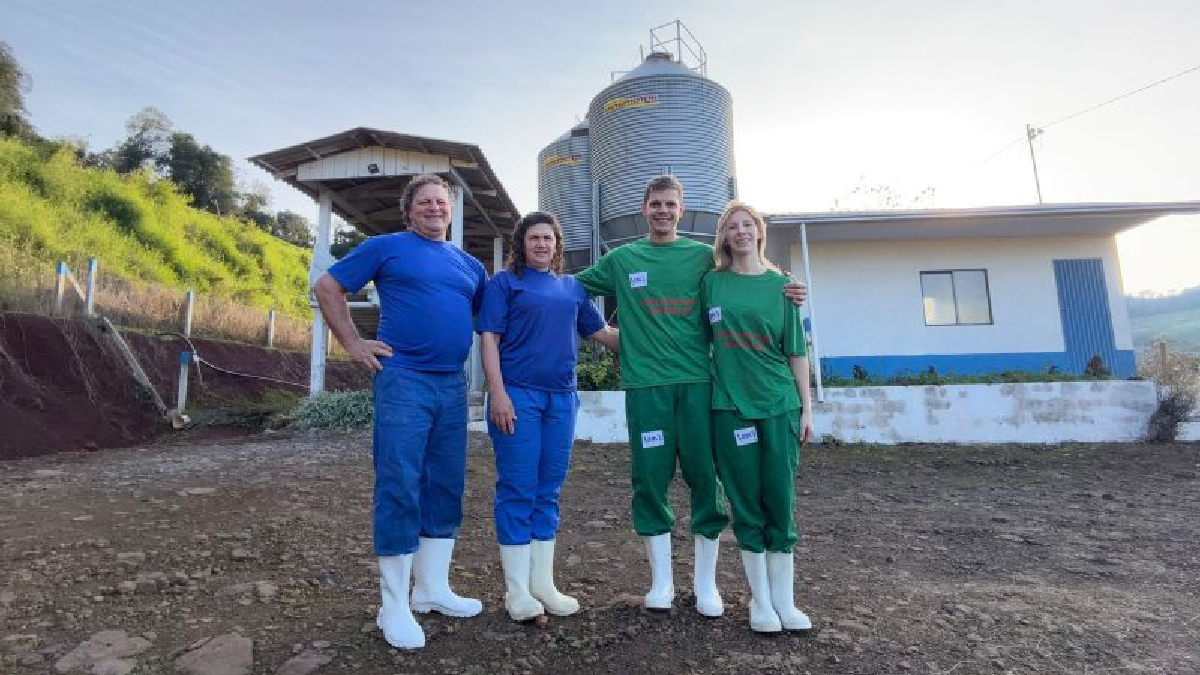
With a focus on management and technology, Jovem SuperAgro prepares participants to lead businesses and face the challenges of an increasingly competitive agribusiness sector.
The program comprises nine modules developed by Seara in partnership with Sebrae.
JBS, through Seara, is launching a groundbreaking youth entrepreneurship program focused on family succession in agribusiness. The Jovem SuperAgro program prepares rural producers, aged 18 to 30, to take over the management of farms integrated with Seara, combining technical training, technology, leadership, and strategic management. The initiative seeks to accelerate the formation of a new generation in the field that is more connected, efficient, and prepared for the challenges of modern agriculture.
Lasting 18 months and in a hybrid format, the program comprises nine modules developed by Seara in partnership with Sebrae, in Santa Catarina and Rio Grande do Sul. Sixty young producers were selected for this initial phase of the program. The content combines theory, practice, and specialized mentoring, connecting the daily operations of farms to the latest advancements in rural management. Topics covered include technology applied to agriculture and sustainability, as well as skills such as leadership, negotiation, communication, and self-awareness.
“Family succession is one of the main challenges in Brazilian agribusiness and, often, it still happens in a poorly structured way, whether due to cultural issues or the difficulty in identifying when a young person is ready to take over management. Therefore, we understand that it is important to support this process, offering training and tools for the continuity and strengthening of rural businesses ,” says José Antônio Ribas Junior, Executive Director of Agriculture at Seara.
Technology emerges as an ally to make farm management more modern, efficient, and connected to the routines of new generations. “Today, digital transformation allows for the control of key production indicators via mobile phone, even remotely, facilitating management and improving the producer’s quality of life. We want to show young people that rural properties can be highly technological, efficient, and profitable ,” emphasizes Ribas.
Brazilian agribusiness has its roots in families that build and maintain agricultural production across generations. According to the latest Agricultural Census from the Brazilian Institute of Geography and Statistics (IBGE), the country has approximately 5 million agricultural establishments employing 15.1 million people, with 77% of these establishments classified as family farms. In this context, ensuring succession is fundamental for the continuity of production, income generation, and economic and social development.
The scenario becomes even more relevant given the country’s demographic transformations: between 2010 and 2022, Brazil lost approximately 4.3 million residents in rural areas, reinforcing the need for initiatives that encourage young people to remain in and take a leading role in the countryside. It is in this context that the Jovem SuperAgro program emerges.
For pig farmer Maicon Toffoli, 28, from Seara (SC), one of those selected for the program, the technological innovations presented in the program represent one of the greatest opportunities to make the property more efficient and prepared. “All the knowledge that comes along to add value makes a difference and ends up reflecting in improvements for the farm. Today, the activity demands attention to several fronts, especially technology, since we work with increasingly automated processes. My expectation is to acquire knowledge that can be applied in the day-to-day operations of the property and contribute to the growth and continuity of the family business ,” he says.
The father, Larri Toffoli, sees the program as an opportunity to prepare the next generation for modern agribusiness. “It’s a very important initiative to guarantee the continuity of the farm, an activity that has been part of our family for generations. As an only child, if he doesn’t continue the work, we would need to look for alternatives ,” he explains. The involvement of families is one of the distinguishing features of Jovem SuperAgro. Even in the first module, parents and children participate together in the activities, a synergy between the experience of the parents and the vision of the new generations.
Generational renewal is, in fact, one of the major bottlenecks in Santa Catarina’s agribusiness. Of the more than 321,000 active rural producers registered in Santa Catarina, only 1 in 10 shows evidence of family continuity in the field, with children already linked to rural activity in official records, according to a survey conducted by Sebrae-SC based on data from the Santa Catarina State Finance Secretariat (SEF/SC).
The Jovem SuperAgro program is part of the SuperAgro Platform, Seara’s main tool for building relationships with its more than 10,000 integrated poultry and swine producers across the country. Created over a decade ago, the initiative has consolidated a unique partnership model in the sector, bringing together actions for recognition, performance monitoring, technical and managerial training, and ongoing support for producers and their families in the states. In the last 10 years, the company has invested more than R$ 4 billion in the initiative.
The results demonstrate a direct impact on integrated farms. The first cohort of Mulheres SuperAgro, a women’s entrepreneurship program, helped integrated farms increase their revenue by up to 7%, in addition to improvements in production quality. Launched in 2024, the women’s program is already in its second edition. Adding together all the cohorts of Mulheres SuperAgro and the recently launched Jovem SuperAgro, more than 120 women and young people have already participated in the company’s entrepreneurship initiatives, reinforcing Seara’s commitment to the training of new leaders, sustainable development, and succession in the field.
“In a scenario where talent retention in the field is vital, investing in the new generation represents more than preparing successors: it means ensuring the continuity of a legacy built by producing families and strengthening the future of Brazilian agribusiness ,” emphasizes Ribas.



Recent Comments