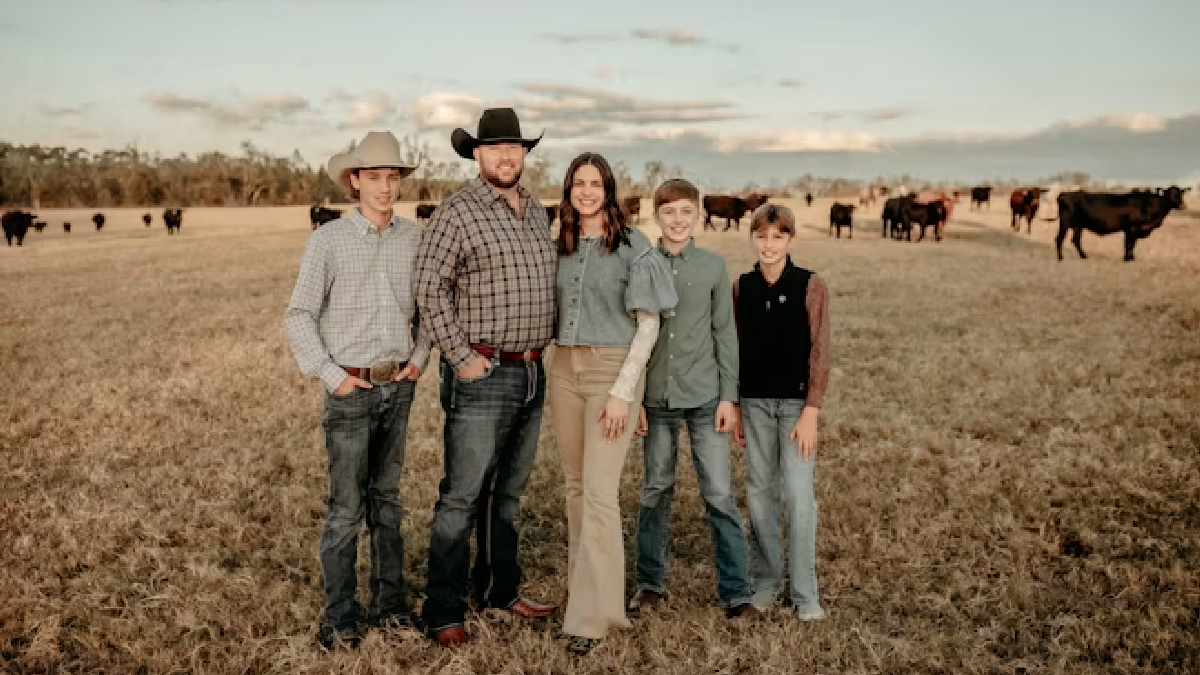
For Josh Churchwell, ranching has always been about staying connected to agriculture and building something lasting for his family.
Raised in Florida, he grew up in 4-H and around livestock, but without a family operation to return to, he carved his own path in the industry. While attending the University of Florida, he began managing a beef cattle operation, an experience that became the foundation for what came next.
After college, Josh and his wife, Lauren, started their own operation on leased land, building a cow-calf herd while balancing off-farm jobs and raising a family. They purchased their ranch in Madison, Florida, in 2013 and have steadily grown the operation since.
Today, the Churchwell family runs about 200 head in a cow-calf system, supplying Wagyu cattle for JBS USA’s Imperial American Wagyu Beef program. Their three sons, Jacob, Jackson and Jonathan, are actively involved, helping manage daily work.
“We’re first-generation ranchers and farmers, even though we were both involved in agriculture,” Josh said. “Our kids, all three of our boys, have been raised up in this. It’s something that we’re proud of.”
The foundation – and the realities of running a smaller operation on limited land – shaped how Josh began thinking about the future of his business.
Finding opportunity in Wagyu
Josh’s operation began producing Wagyu calves about seven years ago. At the time, he was looking for a better marketing opportunity for his calves and a way to differentiate his operation beyond traditional cattle channels.
As a smaller producer, he was already investing in management practices like health protocols, preconditioning and detailed recordkeeping, but those efforts weren’t always fully reflected in conventional marketing outcomes.
Wagyu offered a different path.
“The thing that intrigued us about Wagyu is we were just looking to get out of a commodity market,” Josh said. “We didn’t want to have just a commodity that everybody else did, because we weren’t going to have the quantity. We really chose quality over quantity.”
That opportunity is supported in part by programs like Imperial American Wagyu Beef, a branded premium program that connects producers to a consistent, value-driven supply chain. For producers like Josh, it provides a clearer pathway to align cattle performance, management practices and end-product quality with consumer demand.
The program also fit well with the structure of his ranch. Through the Wagyu program, the family leases bulls for the breeding season instead of maintaining bulls year-round. That matters on a smaller land base, where pasture space is valuable and every management decision has to make sense.
“We wouldn’t have to manage the bulls throughout the year,” Josh said. “We could just get them for our breeding season, and it freed up some pasture where we could expand, because land was a limiting issue for us.”
The transition was not a leap taken lightly. At the time, Josh said there were not many producers in his area raising Wagyu. He leaned on people he trusted, including experienced Florida cattlemen who helped him think through the decision, run numbers and understand the opportunity.
Trust was essential.
“I didn’t think it was going to be a fly-by-night thing,” Josh said. “I felt it was something that we could trust and build a relationship with, something we could do long term.”
A program that rewards doing things right
For Josh, one of the most important parts of the relationship with JBS and Imperial Wagyu is that it rewards the kind of management he and his family were already trying to practice.
Their calves are typically weaned at six to seven months of age, then preconditioned for 60 days before being sold at around nine to 10 months old. The family pays close attention to nutrition, health, and records. They also use cutting edge technology for individual recordkeeping and to monitor reproduction and animal health.
Josh believes that kind of day-to-day management is essential to producing quality beef.
“You also have to have day-to-day management,” he said. “We always have eyes on these cattle. We know the cattle. You’ve got to have good recordkeeping. If you can’t measure it, how can you manage it?”
The Wagyu genetics add another layer of value. By crossing Wagyu bulls with their commercial cattle, Josh says they are able to produce American Wagyu calves that bring improved quality and consistency.
“When we make an American Wagyu, we increase the grade and the quality of the beef that we were already making,” he said. “We’re always wanting to do something better.”
He also appreciates the temperament of the cattle. For a family operation where children are actively involved, disposition matters. Josh says the Wagyu calves are calm and manageable, which allows his family to handle more work themselves.
“With us just being a family operation, we like bringing in the Wagyu,” he said. “They’re a very calm breed. My kids can get in the pens and work with those calves. We can manage it ourselves without outside help.”
A direct relationship that supports a small operation
As a smaller producer, Josh sees the JBS relationship as a practical business partnership. It gives his ranch a more direct path to market and helps the family capture value for the quality of cattle they raise.
“When we’re able to partner with a great resource like JBS, we feel like we’re able to sell direct,” Josh said. “We have a more direct line of contact.”
For a family ranch, that direct relationship can be meaningful. It helps reduce uncertainty and gives the operation a clearer home for the calves it works all year to raise. It also provides financial incentive for management practices that support animal health, product quality and consistency.
“At the end of the day, you’ve got to do what’s right financially for your business, for sustainability, to stay in business,” Josh said. “It’s nice to be able to get rewarded for doing the right thing as well.”
Josh says that relationship with JBS has proven itself over time.
“Everybody involved has been great to us,” he said. “They’re easy to work with. They do what they say they’re going to do. And we just want to do the same thing on our end and make sure we’re living up to our side of the agreement.”
That kind of consistency matters for producers making long-term decisions. Ranching is not a business built one season at a time. Decisions about genetics, land, facilities, nutrition and family succession can play out over years. Having a reliable market relationship gives ranchers like Josh more confidence as they plan for the future.
Raising cattle, raising kids
While Wagyu has helped Josh’s ranch build a stronger business model, the heart of the operation remains family.
His oldest son, nearly 16, has become an important part of the ranch and is deeply involved in the day-to-day work. He’s also taken an interest in the technical side of the operation, including recordkeeping and technology – something Josh sees a natural next step for the business.
“He loves it,” Josh said. “He’s passionate about it. He’s been growing up through 4-H and FFA.”
For Josh, involving the next generation means more than assigning chores. It means giving his sons a real understanding of the business, the finances, the land and the responsibility that comes with livestock.
Succession planning is already part of the conversation, even though the boys are still young.
“You always have to be thinking ahead in probably any business, but especially the cattle and livestock business,” Josh said. “We do want to be able to keep this land in our family and keep it going if our kids choose to go down that path.”
He wants his sons to have choices. If they decide to stay in agriculture, he wants them to be prepared. If they choose other paths, he still wants them to understand the value of the work and the land.
“We try to get them involved so they at least have an understanding of succession planning and finances at a younger age than probably I was,” Josh said.
Taking pride in Wagyu
When Josh talks about Wagyu beef, he does so as someone who’s seen the work behind it from the pasture level. He knows the time, management, and family effort that go into every calf.
He also believes consumers are increasingly interested in higher-quality beef and in knowing more about where their food comes from.
“We feel good that we’re producing a high-quality product that the consumer wants,” Josh said.
He doesn’t see Wagyu as a replacement for other beef products, but instead as a premium option that reflects genetics, management, and attention to detail.
“We are very confident to stand behind our Wagyu,” he said. “That’s what we want to do as a producer. Our name, our reputation, is to produce a really good quality product.”
Asked how he likes to prepare Wagyu himself, Josh’s answer is simple: outside, over charcoal, with family and friends nearby.
“My relaxation is to get out and grill,” he said. “I’m going to light the charcoal grill, probably throw a ribeye steak on there, get it to about medium rare and enjoy it with some friends and family.”
The people behind the product
For JBS, relationships with ranchers like Josh are an important part of bringing products such as Imperial American Wagyu to consumers. For Josh, the partnership provides a practical market opportunity that fits his family’s scale and values.
It’s not just about selling calves. It’s about building a relationship that allows a smaller ranch to focus on quality, plan for the future, and remain connected to the industry Josh has loved since childhood.
“We enjoy the industry and enjoy the people we get to work with,” Josh said.
On his ranch in northern Florida, the days are full and the work is constant. There are calves to check, hay to put out, records to update, and kids to get to school. But for Josh, Lauren and their family, that rhythm is part of the reward.
They are building a ranch, raising sons, caring for land, and producing beef they are proud to stand behind.
“We couldn’t think of any other way that we’d want to raise our kids,” Josh said. “On the ranch, on the farm, in the agriculture industry, teaching them about where their food comes from. That’s what we’re most proud of.”