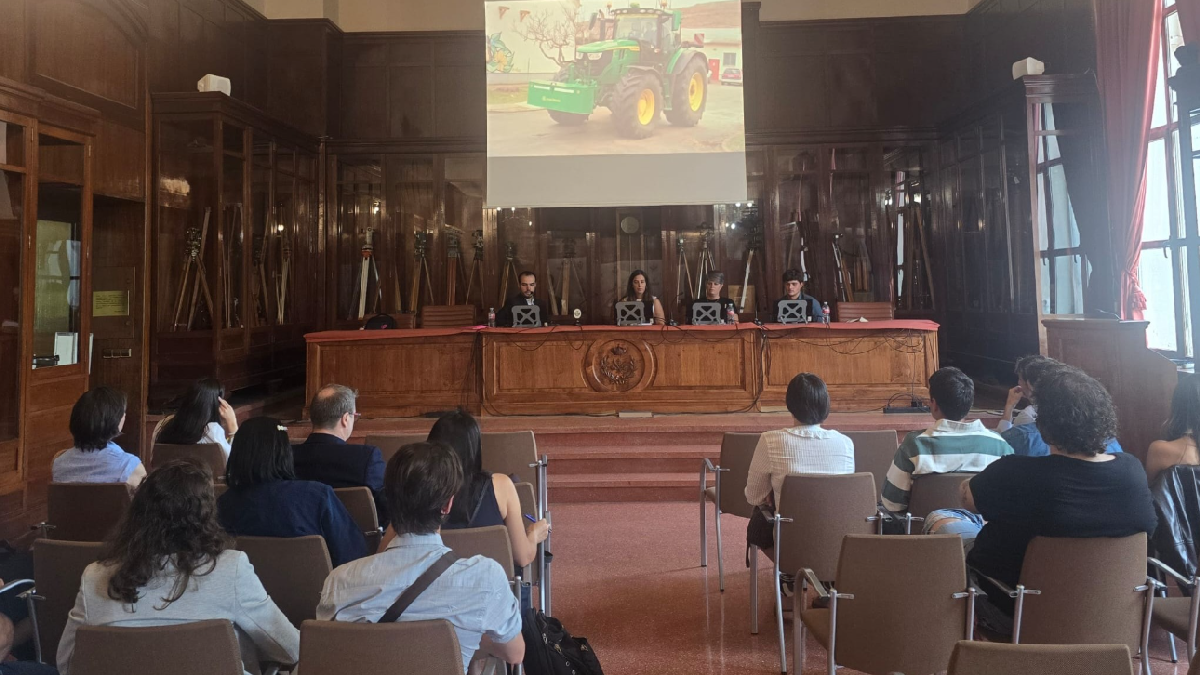
Innovation, technology, and professional opportunities focused their participation in the II Youth Forum on Spanish Agri-Food Systems.
INTERPORC highlighted the professional and personal development opportunities offered by the white swine sector and the rural environment during its participation in the II Youth Forum on Spanish Agri-Food Systems.
Under the title “The future of the countryside is also young: perspectives and opportunities for a new generation”, INTERPORC brought together young professionals to address generational renewal from different angles: agricultural entrepreneurship, family business continuity, and innovation. The round table, moderated by Miguel Roses from INTERPORC’s International Department, featured Marta Llorente, a livestock farmer, grower, and winemaker in the DO Ribera del Duero; and Hugo Álvarez, a white swine farmer in Segovia integrated into a family business that encompasses all three stages of production.
Their experiences showcased various pathways to joining the sector and building a life project in rural areas. Throughout the meeting, key topics were addressed, such as daily life on farms, intergenerational learning, work-life balance, as well as the challenges and opportunities associated with entrepreneurship and professional development in agriculture.
Innovation and technology also played a prominent role, with special emphasis on their application on farms and their contribution to improving working conditions and the efficiency of production processes. In addition, the panel discussed the possibilities offered by artificial intelligence, training in new technologies, the circular economy, and the utilization of by-products.
Greater voice and visibility
INTERPORC stressed the importance of highlighting the diverse career paths available in rural areas and accompanying these opportunities with training, support, and services that facilitate both the entry and retention of younger generations.
As a key conclusion, the participants called for greater visibility and recognition of the work done by livestock farmers, as well as a more active presence of their voices in discussions regarding the future of the countryside. In this regard, they highlighted the importance of having industry professionals themselves explain to society the reality of working in rural environments, the opportunities it generates, and the challenges it faces.
In this context, the work of representative organizations like INTERPORC helps bring the reality of the sector closer to society, amplify the voices of its professionals, and foster greater knowledge and recognition of their activity. This task is particularly relevant so that new generations can learn firsthand about the professional and personal opportunities offered by rural areas and consider them a viable space to build their future.