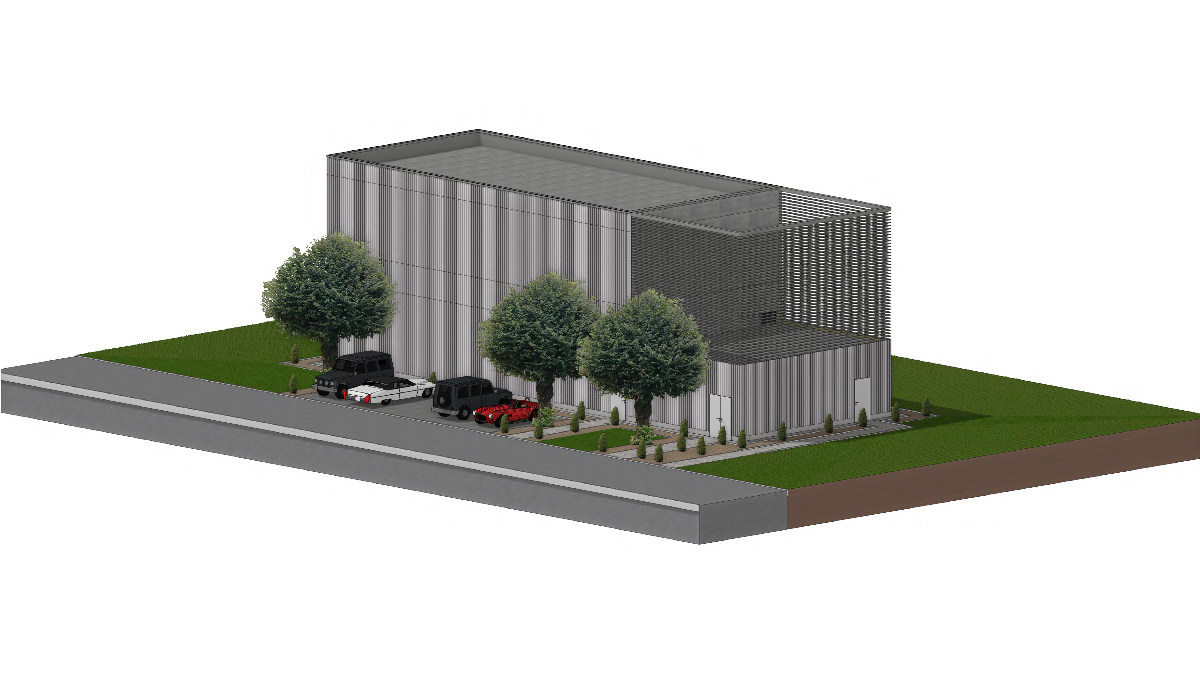
An intelligent energy system is expected to make the location 80 percent self-sufficient, significantly reduce CO₂ emissions, and provide long term planning reliability.
At their location in Neubrandenburg, Weber Food Technology intends to show how the energy supply for a modern industrial operation can be future-proof. The family-owned company is planning an integrated energy system that combines the generation and storage of renewable energy with the requirements of production, buildings, heating and cooling, as well as mobility. The goal is to make improve the reliability of the energy supply, make energy costs more predictable in the long term, and significantly reduce the site’s carbon footprint.
The roofs of the plant buildings at the Weber site in Neubrandenburg are already completely covered in photovoltaic panels, making a key contribution to the energy supply. But that contribution will continue to grow even more: The building and heat supply are increasingly electrified, the company’s fleet of vehicles is being converted to electric mobility step by step, and production methods are also developing. Electricity thus becomes the central energy source of the entire site. In order to meet this growing demand reliably, economically and as sustainably as possible, Weber relies on the step-by-step construction of an intelligently controlled energy system consisting of several components. Renewable energy will be generated on site, stored, and used exactly when it is needed. A total of 3.6 megawatt peak (MWp) photovoltaic power and two small wind turbines with a combined output of 0.5 megawatts are planned. This should allow around 5.5 gigawatt hours of renewable electricity per year to be generated at the site in the future.
The key feature tying the entire system together is a large hybrid energy storage component. With a capacity of around 10.4 megawatt hours and a maximum output of 4.3 megawatts, it combines two different storage technologies. A redox flow battery forms the large energy tank of the system. In this technology, energy is stored in a liquid that is kept in tanks. That way, the capacity can be expanded comparatively easily by adding additional tanks with additional storage fluid. In other words, the storage unit can grow along with the location’s energy needs. The redox flow battery is supplemented by a lithium iron phosphate battery. These batteries can react especially quickly and store or provide large amounts of power in a very short time. The interaction of both technologies thus combines high storage capacity with fast availability. “With this project, we are laying the groundwork for supplying our location reliably and economically in the long term, achieving a self-sufficiency rate of about 80 percent. This reduces our dependence on fossil fuels, energy imports and short-term price developments. At the same time, we are strengthening something that is crucial for competitive industrial value creation in Germany: Reliability of supply and long-term predictability,” explains Tobias Weber, CEO of Weber Food Technology.
The generation, storage and consumption of power are controlled by means of an intelligent energy management system. If the photovoltaic systems and wind turbines produce more electricity than the site currently needs, the excess energy is stored. If consumption increases later, power is channeled back into the local grid. This way, the naturally fluctuating amount of energy generated from sun and wind becomes reliable for industrial operations. At the same time, the storage can reduce load peaks and thereby optimize the use of the public power grid. In total, Weber is investing around eleven million euros in the project. Of that amount, 7.9 million are spent on the hybrid power storage, including the building and infrastructure. The state of Mecklenburg-Vorpommern is supporting the investment in electricity storage with a grant of 3.1 million euros. The funding underscores the importance of the interaction between politics, industry and innovative energy technologies for the practical implementation of such projects.
This concept is turning the Weber location in Neubrandenburg into a practical field test and beacon project. The experience gained during the project will be integrated into the development and energy supply of other locations. In Breidenbach, the second-largest Weber production site, a comparable project with a target self-sufficiency rate of 90 percent is already planned. Step by step, a transferable model for a reliable, economical and sustainable industrial energy supply is created, which not only offers numerous advantages for the company itself, but also for its customers and Germany as a business location.