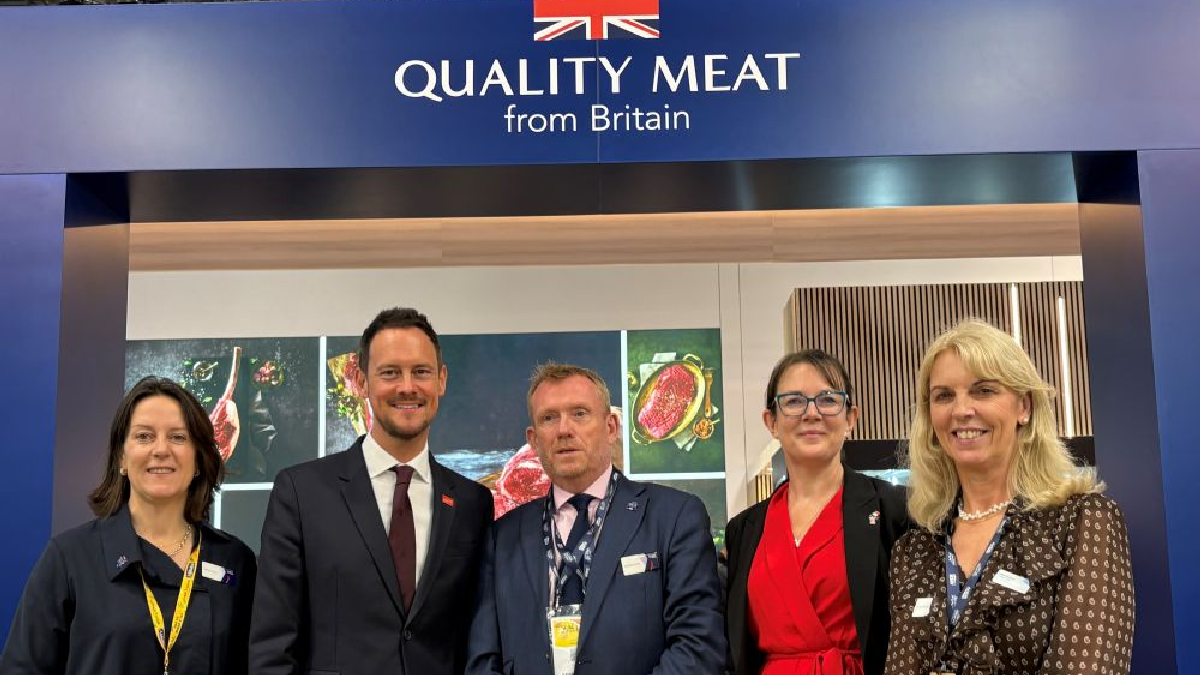
Thirteen export businesses this week joined us at the AHDB pavilion at SIAL Paris, attracting producers, distributors, representatives from food service and importers from markets across the world.
The show provided a platform for exporters to meet with existing customers and the opportunity to make new business connections from around the world.
It builds on an impressive first half of 2026, which saw the total value of UK red meat exports reach £1.1 billion, up 15% on the year, with the volume of product shipped up 8% at almost 293,000 tonnes.
Values of total beef and sheep meat exports for the period increased by 23% to £450 million and 15% to £401 million respectively on the year, largely driven by demand from European markets.
Our pavilion also welcomed a visit from the government’s Food and Farming Minister Stephen Morgan MP, who met with exporters to discuss opportunities and challenges facing the beef, sheep meat and pig meat sectors.
The minister also spoke at the AHDB’s British Meat Dinner, featuring British beef, lamb and pork dishes and organised alongside SIAL, which was attended by around 300 industry and government guests.
Jonathan Eckley, AHDB International Trade Development Director, said: “Total UK red meat exports in the first half of this year in both value and volume were very encouraging, despite a challenging global trading environment.
“Against this backdrop, it has never been more important to ensure that the interests of our levy payers are represented and given maximum exposure on the world stage, reiterating why it is vital to maintain a wide portfolio of markets to maximise carcase utilisation.
“SIAL attracts buyers from across the world and really is the global shopwindow to showcase our world-class produce. We have a fantastic story to tell, and the show provides the perfect platform for us to ensure that the excellent production standards of our livestock farmers and the work of our export businesses in delivering products that are highly sought after the world over are given the recognition they rightly deserve.”
Farming Minister Stephen Morgan said: “It’s fantastic to see 13 British export businesses on AHDB’s pavilion here at SIAL, backing up today’s figures with real commercial relationships being built with buyers from around the world.
“Red meat exports worth £1.1 billion in the first half of this year show the scale of ambition in this sector, and with Europe driving much of that growth, the food and drink deal we’re finalising with the EU will help clear away the paperwork and checks still holding exporters back.”
AHDB continues to deliver a comprehensive programme of international trade development activity on behalf of levy payers to support the red meat and dairy sectors.
Prior to SIAL, this included inward trade missions to the UK attracting buyers from China and the USA, showcasing beef, sheep meat and pig meat production.
Ahead of SIAL, Jonathan and AHDB Chair Emily Norton also joined Secretary of State the Rt Hon Dame Angela Eagle DBE MP and other industry leaders on a trade mission to India.
Earlier in the year, Emily also joined then Secretary of State for Environment, Food and Rural Affairs, the Rt Hon Emma Reynolds MP, and other industry leaders for the UK’s first dedicated agri-food trade mission to Washington DC.
The visit coincided with the first tariff-free shipment of British beef arriving in the USA as part of the UK-US Economic Prosperity Deal, where both countries agreed to implement a reciprocal 13,000 tonne quota for beef.
In the first half of this year, UK beef shipments to the USA increased by 71% on the year at 1,038 tonnes and were worth £5.45 million – up 89.6% on the same period in 2025.
Jonathan added: “Increasing export demand helps create long-term value for our levy payers and supports the resilience and competitiveness of British farming. Our work both in the UK and in-market plays a key role in that and we will continue to work collaboratively with industry and government to help ensure our world class red meat produce continues to take pride of place on the global stage.”
Speaking ahead of SIAL, Lancashire-based sheep, dairy and beef farmer John Alpe said: “As a farmer, I’m passionate about exports as it provides us with access to more markets. Trade missions and showcasing our produce at international trade shows is crucial.
“As an individual farm business, we can’t affect that, but as a collective of levy payers throughout the country, it gives us more bang for our buck in giving us the opportunity to be seen and build relationships right across the world.”
Arable and sheep farmers could benefit from co-operating on cover crop grazing
The growing popularity of winter cover crops, changes to EFA requirements and the opportunity for arable farmers to boost their income should make overwintering sheep a worthwhile option on many farms this year.
Beth Alexander, Monitor Farm Scotland programme manager says: “There is a real opportunity for arable and sheep producers to benefit from working together over winter. There are many sheep farmers looking for winter grazing for sheep, and in many cases, arable farms with winter cover crops have great potential for grazing.”
In East Lothian, Niall Jeffrey’s arable acreage has proved to be a good overwintering opportunity for sheep breeder and lamb finisher Doug Pate from Marvingston. The pair are about to enter their second winter of grazing after Doug ran 400 store lambs across about 100 acres of Niall’s cover crop of spring oats last winter. The lambs arrived in mid-November, leaving the farm in mid-January.
Niall says: “I think there’s a real benefit of having the sheep eating the cover crop. It’s not tangible, but recycling nutrients through a ruminant adds a biological factor. Grazing seems to help when I plough down the crop too – I didn’t need to apply glyphosate.”
This summer, he has ‘drilled’ feed oats at 120kg/ha using a fertiliser spreader set to 18m, followed by a pass with 5m discs to 5cm depth. “I had no time to roll the crop, but it’s through the ground now and looking good.
“I want to grow the cover crop as cheaply as possible, but to make a good job of it so there is plenty to graze. I chose oats as a cover crop as they’re not in my rotation, they grow extremely quickly and I think they supress weeds. The money from the sheep also helps to offset costs.”
Niall adds: “I’ve had questions about whether grazing cover crops pushed up N levels in the following malting barley crops, but if anything, our N levels were lower. I think the oats soak up some N, and nutrient cycling is also quite slow.”
For grazier Doug, the oat cover crop is good for store lambs. He has a preference for grazing stubble turnips or forage rape as they are higher in ME and protein, but brassica crops aren’t an option on farms with oilseed rape in the rotation due to clubroot concerns.
Choosing cover crops which sheep can and will eat is important. “Some plants such as phacelia, radish and vetch aren’t palatable for sheep.”
Doug prefers grazing land in blocks so sheep don’t have to be transported while they are on farm, and as he runs multiples of 200 lambs (a trailer load), he looks for enough grazing to keep them for at least a month, preferably more. The cost of haulage is an important factor for his business.
Farms with permanent fencing are ideal and likely to benefit from higher payment rates. Electric fencing is an option, with Doug using an ATV and Rappa winder system which allows two people to fence 20 acres in an hour and a half.
Niall’s fields have permanent fencing and most have water; an IBC with water was provided in the field which didn’t have a water supply. His land is in 75-acre blocks, which made grazing the sheep straightforward, however a further 30 acres of cover crop which was not in the block was not grazed due to the logistics of having to move sheep to it. In general, payment for grazing starts at 50p per head per week, depending on the type of crop and whether the land is fenced.
He adds that thinking about the class of stock is important if there are other stock on the farm; breeding ewes which need to be taken home for scanning, dosing, etc can trigger a standstill when they return to the farm. Store or finishing lambs are more straightforward.
Doug is entirely responsible for the sheep, although Niall will contact him if he notices any problems. Both believe that making the system and relationship work is down to common sense, while the payment aspect also helps. Doug adds: “It makes for a better relationship.”
Scottish Government changes to EFA requirements – which now allow stubble turnips to be grown and being able to graze cover crops before 1 January – could transform the co-operation opportunities for arable farmers and graziers. “It’s a definite step in the right direction and completely opens this up,” says Niall.
Doug adds: “If you’re growing cover crops for greening, grazing is money for old rope. I think the key is to talk to potential graziers to make sure you are planting what their sheep will eat, and to establish cover crops as early as possible so they grow well.”