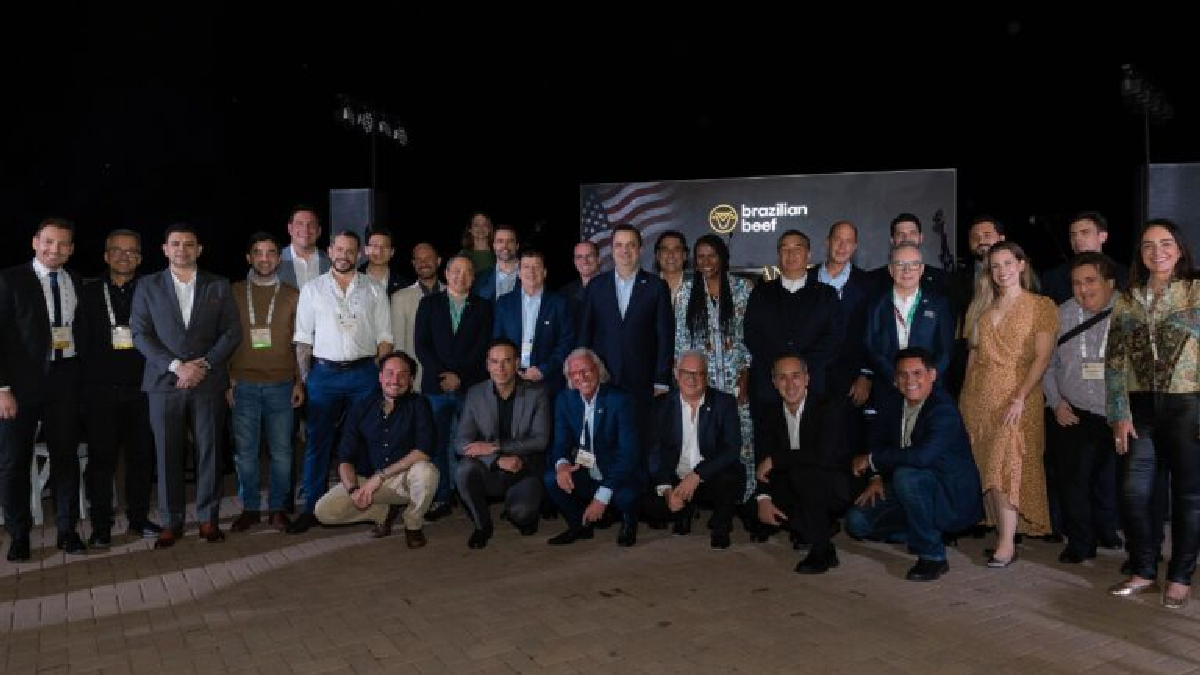
Participation of 18 companies associated with ABIEC generated US$17.3 million in closed deals, 264 business contacts, and an expectation of US$500 million for the next 12 months.
The participation of the Brazilian Beef project, developed by the Brazilian Association of Meat Exporting Industries (ABIEC) in partnership with the Brazilian Trade and Investment Promotion Agency (ApexBrasil), in the 65th Annual Conference of the Meat Import Council of America (MICA), resulted in US$17.3 million in deals closed during the event and an expectation of US$500 million for the next 12 months. Held from November 2nd to 4th in Scottsdale, Arizona (USA), the meeting included 18 companies associated with ABIEC, which established 264 business contacts, involving the markets of the United States, Canada, Mexico, Chile, Argentine, Paraguay, and Uruguay.
One of the main gatherings of the international meat industry, MICA brought together importers, exporters, authorities, and experts to discuss the prospects of the American market, trade policies, sanitary inspection, and logistics. The program included representatives from the United States Department of Agriculture (USDA), analyses of the meat market, and debates on port infrastructure and supply. Brazil was also represented by Augusto Billi, Secretary of Trade and International Relations of the Ministry of Agriculture and Livestock (MAPA), who participated in the conference program.
The Brazilian Beef delegation was made up of the following companies: Agra, Astra, Barra Mansa, Beauvallet, Cooperfrigu, Estrela, Frialto, Friboi/JBS, Frigol, Frigomarca, Iguatemi Beef, Intertrans, MBRF, Minerva, Naturafrig, Plena, Prima Foods, and Sudambeef.
As part of the agenda, ABIEC and ApexBrasil hosted the Brazilian Beef Signature Reception on November 3rd, bringing together North American importers, representatives of the Brazilian industry, authorities, and business partners at The Westin Kierland Resort & Spa.
Led by Lhais Sparvoli, Director of International Relations at ABIEC, the reception included speeches by Roberto Perosa, president of the organization; Alberto Carlos Bicca, Agribusiness Coordinator at ApexBrasil; Mike Skahill, Executive Director of MICA; and Augusto Billi, from MAPA. Ana Lúcia Viana, Brazil’s agricultural attaché in the United States, was also present.
“The United States is a key market for Brazilian beef, and we are in a position to expand our share in supplying the American industry. Our production complements the local supply and meets an important demand from importers. We want to take advantage of these opportunities and expand our supply to the American market. I especially thank Mike and the MICA team for their receptiveness, ApexBrasil for the partnership, the representatives of the Brazilian government, and our associates, who are here strengthening these trade relations,” Perosa highlighted.
In addition to the trade agenda, the president of ABIEC represented Brazil on a panel about trade policies, held on November 4th, with representatives from New Zealand, Japan, Australia, the United Kingdom, Ireland, and Argentina. Moderated by Steve Sothmann of MICA, the debate addressed the challenges of international trade and the conditions of access to the American market.
Perosa also highlighted the role of Brazilian beef in supplying the North American industry, especially in providing lean meat used in the production of ground beef and hamburgers. He also advocated for greater predictability in trade rules, given the tariff restrictions faced by the sector and the need to ensure stable conditions for exporters and importers.
The United States is the second main destination for Brazilian beef. Between January and October 2026, exports totaled 352,900 tons and US$2.33 billion, representing a growth of 52.2% in volume and 68.7% in value compared to the same period in 2025. The market accounted for 13.25% of the volume and 14.98% of the total revenue of Brazilian exports.
This performance comes after a period of tariff restrictions, when Brazilian beef faced tariffs of up to 76.4% in out-of-quota operations. Currently, Brazil has approximately 50 meat processing plants authorized to export to the United States, a market that maintains significant demand for Brazilian beef, especially to supply its processing industry.