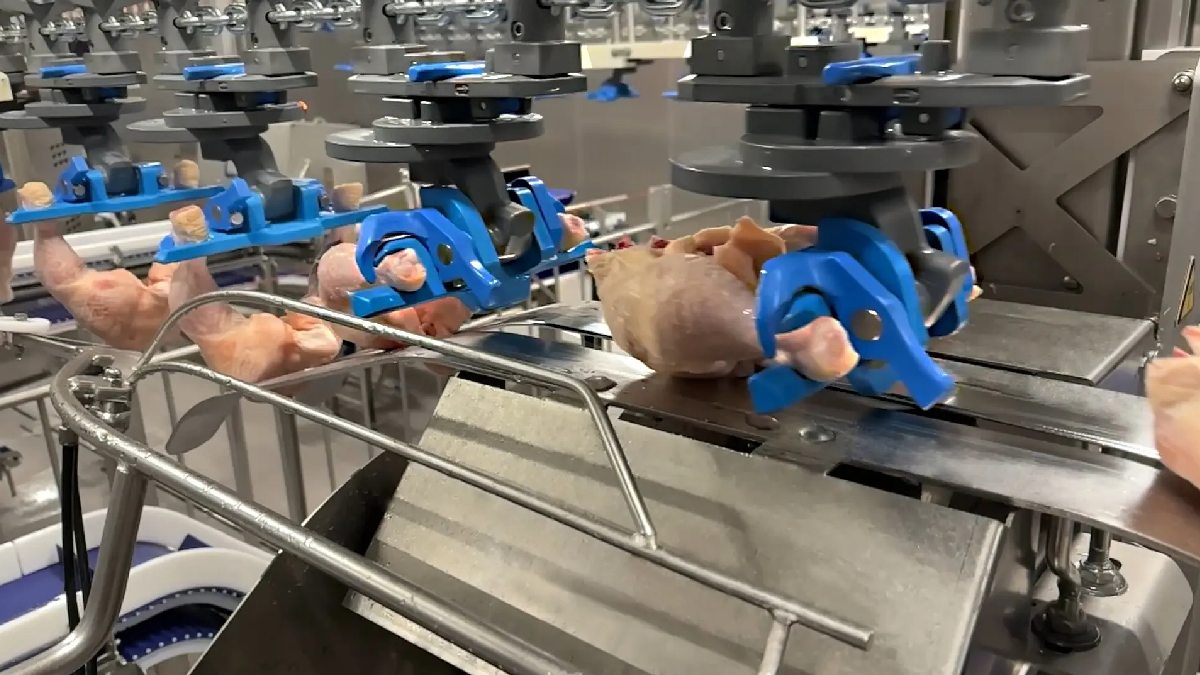
TailCutter HP performs consistently, even with wide flock variations
In some markets, the chicken tail is simply a part that needs to be removed to allow for precise anatomical leg cutting. But in other markets, tail meat is an edible, valuable food ingredient that deserves to be carefully harvested. The JBT Marel TailCutter HP in the ACM cut-up line can do it all.
In the ACM-NT cut-up line, the TailCutter HP module is placed between the Breast Cap Cutter or Front/Back Half Cutter and the leg cutter. It forms a perfect combination with the already legendary ALPINE anatomic leg processor (also present at VIV Europe 2026). The TailCutter does what it says: it automatically separates the tail from the saddle with utmost care and without damaging the tail or the thigh meat.
Virtually no adjustments
Removal of the tail allows for anatomic leg processing downstream. The TailCutter HP in the ACM cut-up line works simply and cleanly. Once the module has been set up during installation, virtually no further adjustments are needed, even with wide flock variations or different breeds. Horizontal positioning and two guides ensure a good cut regardless of carcass size. There is no need for skilled labor.
Market requirements
The TailCutter HP handles back halves or saddles. During installation, it is possible to predefine the exact cutting point between carcass and tail that meets market requirements. In some markets, it is important to add more back skin to the tail, particularly where the tail itself is considered a valuable product. When the market requires non anatomical quarter legs (including split tail and spine), the TailCutter can be easily bypassed.
The TailCutter HP handles flock variations well, performance remains consistent at all times.
Consistent performance
Thanks to the TailCutter HP’s ability to handle flock variations well, performance remains consistent at all times, delivering the same high-quality result for every carcass. As the TailCutter runs fully automatically, no specialized operator is required, and even knife replacement is simple. The module is also easy to clean with low maintenance needs that save time and reduce downtime. Its robust, reliable operation makes the TailCutter HP a smart choice for any high speed ACM-NT cut up line.
How are chicken tails eaten?
As with most parts of the chicken, the tail is also suitable for human consumption. In many cultures, particularly in Asia, Africa, and parts of the Caribbean, chicken tail is a familiar food. Besides being enjoyed as a snack or appetizer, chicken tails are used in soups, dim sum, or stir fries to add depth and richness to the taste. When deep fried, grilled, or roasted, they are often served on skewers (as bonjiri yakitori in Japan) or incorporated into stews. In these dishes, chicken tails are a tender and crispy delicacy.