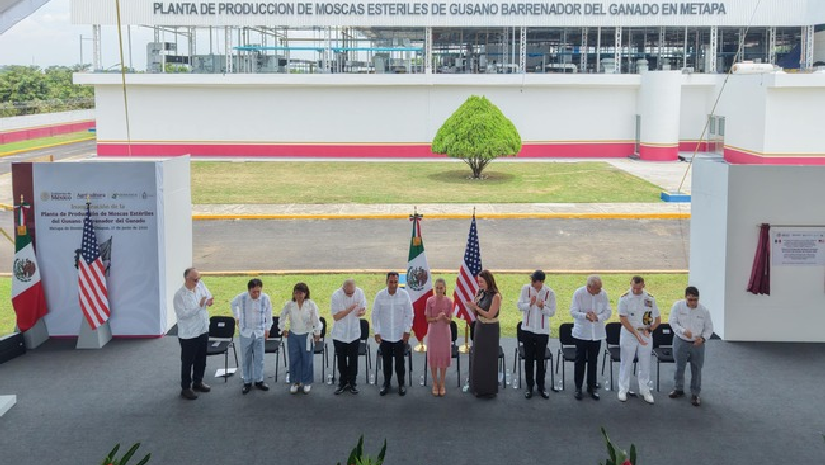
This strategic infrastructure is key to protecting the livestock industry, public health, the environment, and food sovereignty of both nations.
Ministry of Agriculture and Rural Development | June 27, 2026 | Press Release
The United States government announced an additional investment of $83.8 million to strengthen efforts to prevent, control, and eradicate GBG.
The governments of Mexico and the United States inaugurated the sterile screwworm fly (SWV) production plant in Metapa de Domínguez, Chiapas, in order to strengthen the binational strategy for the prevention, control and eradication of this pest.
In a historic event, led by President Claudia Sheinbaum Pardo, strategic infrastructure is key to protecting the livestock industry, public health, the environment, and food sovereignty of both nations.
In her remarks, the Secretary of Agriculture and Rural Development, Columba Jazmín López Gutiérrez, highlighted the joint work and funding to take “a great step in protecting the health of all warm-blooded animals,” and noted that efforts should focus on the comprehensive management of the pest in its different stages of the life cycle.
She recalled that since November 21, 2024, when the first case of GBG was detected in Catazajá, Chiapas, a coordinated strategy was implemented with the National Service for Agrifood Health, Safety and Quality (Senasica), the AGRICULTURE Representation Offices in the states and the livestock sector to contain the impact of this pest and prevent its advance in the national territory.
Since then, she indicated, the work has allowed the inspection of more than 5.3 million head of cattle, the verification of 84,000 shipments, and the release of almost seven billion sterile flies with the support of more than two thousand veterinary specialists and field technicians, who have been joined by more than 400,000 farmers with the installation of 578,000 artisanal traps to capture 13 million flies and more than four thousand technicians focused on monitoring the pest from the Sembrando Vida Program.
To strengthen these efforts, the federal secretary announced that a new strategy for the prevention, control, and eradication of GBG in Mexico will be promoted with the Secretaries of Agriculture and Rural Development —from the 32 states— in order to coordinate, monitor, and evaluate actions related to dissemination, training, surveillance, control of movement and production, and the release of sterile flies in free zones, eradication zones, and zones under control.
U.S. Secretary of Agriculture Brooke L. Rollins hailed the construction of the sterile fly production facility as a milestone and recognized Mayor Claudia Sheinbaum as an extraordinary ally. “Our countries have defeated this pest before, 40 or 50 years ago, and we will do it again thanks to the extraordinary work we will carry out with this facility,” she stated.
The United States Ambassador to Mexico, Ronald D. Johnson, welcomed this historic event because it reaffirms the collaboration and dialogue between the presidents of Mexico, Claudia Sheinbaum Pardo, and Donald John Trump, and reflects that “when we work together we get results for all our people.”
Therefore, the diplomat announced that the United States government will contribute an additional investment of $83.8 million to the operation of the complex and to strengthen the mechanisms for preventing, controlling, and eradicating GBG in both countries. “The objective is clear: to eliminate this pest to protect livestock, trade, and food security in the United States and Mexico.”
The new plant will begin operating on June 28th and by mid-July will produce 28 million sterile flies each week, an amount that will gradually increase to reach 100 million by the end of 2026; once that maximum projected capacity is met, Senasica specialists will analyze the possibility of expanding production to 120 million per week.
The biofactory in Metapa de Domínguez, Chiapas, will add its production to that of the Pacora production plant in Panama, which has been operating at its maximum capacity —100 million sterile flies per week— since 2024 to supply biological material to Central America and later to Mexico and the United States.
It is important to mention that the release of sterile flies is part of a regional strategy for the containment and eradication of the GBG plague, whose main component is to strengthen actions in the field such as the detection and treatment of wounds in warm-blooded animals, the attention to notifications, epidemiological surveillance, the regulation of livestock movement, the promotion of notification and training to producers and the general population.
The measures are intended to reduce fly populations and provide data on the proper functioning of the Sterile Insect Technique (SIT), so insect releases are carried out in areas with low pest density because at least 10 sterile males are required for each wild fly.
With the start of operations at the Metapa de Domínguez Plant in Chiapas, the control and eradication strategy will be carried out as it has been for more than 40 years, from north to south of the continent until Mexico and the United States are free of the plague and successively each of the countries of Central America.
This will provide an opportunity to confine the plague once again to the Darien Gap, a dense jungle located on the border between Panama and Colombia.