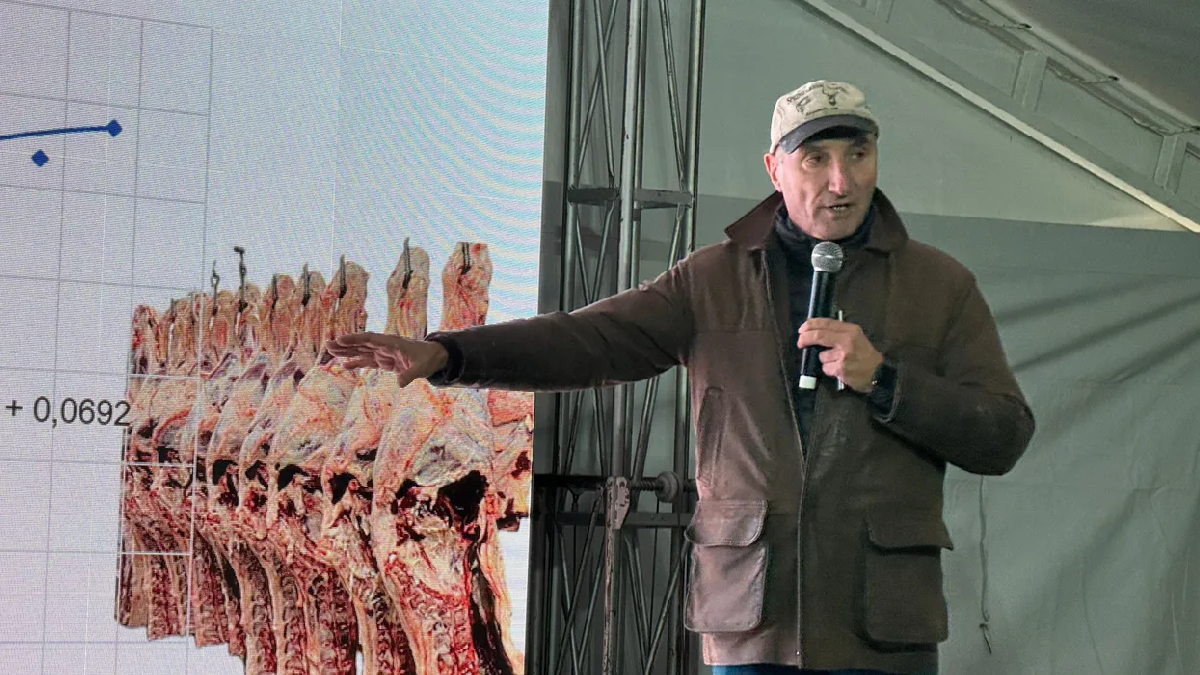
At an IPCVA Field Day, a model was presented that combines genetic selection, intensive rearing and forage planning to increase meat production and improve efficiency.
“The cattle industry is doing very well, and we believe we need to rebuild our stock at a time when the world is demanding beef.” With that statement, Georges Breitschmitt, president of the Argentine Beef Promotion Institute, opened a new Field Day at the La Coincidencia ranch, in the Buenos Aires district.
Under the slogan “Genetics and breeding to maximize meat and conversion: more real kilos for the producer of western Buenos Aires,” the Ipcva meeting allowed participants to learn about a system that integrates genetic improvement, intensive breeding and precision management of forage resources with the objective focused on producing more kilos of meat per hectare.
In the presentation on field management, both INTA researcher Aníbal Pordomingo and livestock advisor Joaquín Prieto agreed that the challenge of modern livestock farming involves transforming more fodder into meat, improving conversion efficiency, and increasing the kilos produced.
Genetics as a productive tool
The genetic project at La Coincidencia is based on the Limangus breed, a biotype stabilized from the crossbreeding of Angus and Limousin cattle. Pordomingo said the research aimed to combine the meat quality, fertility, and early maturity of Angus with the higher carcass yield and feed conversion efficiency provided by Limousin.
However, the approach goes beyond breed selection. The company developed a reproductive system based on embryo transfer that allowed for accelerated genetic progress and rapid scaling of the herd.
Currently, the selection process involves thousands of animals individually evaluated through electronic records, reproductive measurements, and carcass characteristic analysis. Among the parameters assessed are ribeye area, fat thickness, marbling, and estimated live carcass yield.
But among these evaluations, Pordomingo highlighted the incorporation of Residual Feed Intake (RFI), an indicator that allows for the identification of animals capable of producing more while consuming the same amount of feed or, conversely, maintaining their performance while consuming less. La Coincidencia currently has one of the largest facilities in the country for measuring this attribute.
“Conversion efficiency can no longer be evaluated solely by weight gain. It is necessary to measure how much usable meat each animal produces with the resources it consumes,” he summarized.
Rearing
Prieto explained that the entire breeding model was designed to maximize production per unit area. Therefore, planning begins with the available feed resources, not the number of animals to be raised. “First, we determine how much pasture can be produced, and only then adjust the stocking rate,” the consultant said.
The system operates on two rearing farms, El Triángulo and El Peregrino, which together cover approximately 1,700 hectares and receive about 5,000 steers per cycle. The animals enter weighing between 180 and 240 kilos and remain in the rearing program for six to ten months, with daily weight gain targets of between 500 and 700 grams.
The ultimate goal is to deliver animals weighing between 350 and 400 kilos while maintaining high biological and economic efficiency.
Feeding
The company estimates that approximately half of its annual feed demand must be met through silage, primarily corn and barley. Based on this, a stocking rate equivalent to 7 breeding cows per hectare is established, a level well above the regional average.
In addition, the strategic use of concentrated and balanced supplements helps maintain weight gain when pasture availability decreases. “Supplementation doesn’t replace pasture; it allows for better utilization and sustains production when limitations arise,” Prieto explained.
Regarding pasture management, both in the barn and in the rearing fields, intensive rotational grazing is used with daily or hourly paddock allocation. The animals enter areas defined according to prior measurements of forage availability and receive strategic supplementation with silage or hay.
The goal is to increase the harvesting efficiency of the forage produced and “avoid losses due to underutilization.” To achieve this, they rely on infrastructure: electrification to divide the land into paddocks, watering points, supplemental feeding pens, and continuous record-keeping of all animals (weights, health treatments, movements, and productive performance) to correct management practices, adjust stocking rates, and project results.
Both Pordomingo and Prieto emphasized the concept that livestock intensification does not depend on incorporating more technology or more genetics, but on designing an integrated management system: planning feed production, measuring results, organizing processes, and using information to make decisions.
“Producing more meat is not just about having better animals, but about building systems capable of expressing their full potential,” summarized the Inta expert.