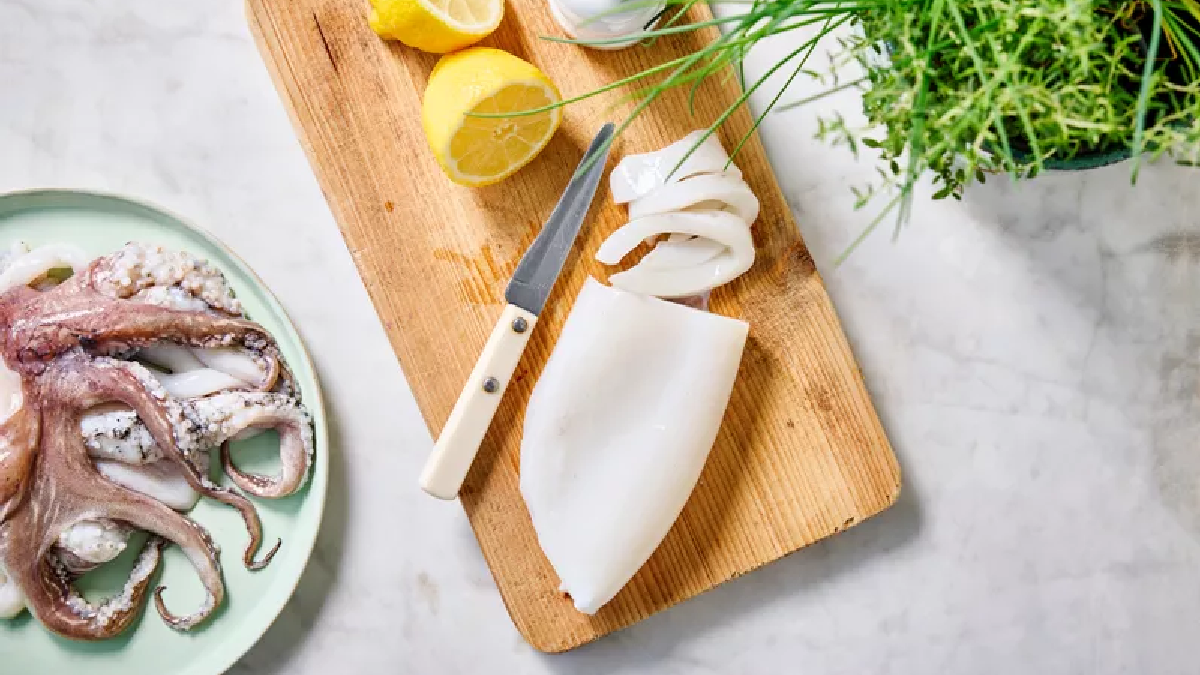
Every year, the Flemish fisheries sector and VLAM name an undervalued fish species as Fish of the Year. This year, the choice falls on the cuttlefish. Hilde Crevits, Flemish Minister of Marine Fisheries, announced the Fish of the Year today in Ostend. Cuttlefish are being caught in increasing numbers by Flemish fishermen; moreover, it is currently the most landed species in the ports.
Every year, the announcement of the Fish of the Year is eagerly awaited, an initiative of VLAM (Flemish Centre for Agro- and Fisheries Marketing) and the Flemish fisheries sector. The selection is validated by ILVO (Institute for Agricultural, Fisheries and Food Research), which investigates whether there is a risk of overfishing.
This year, VLAM and the Flemish fisheries sector have chosen the cuttlefish as Fish of the Year. Hilde Crevits, Minister of Marine Fisheries, announced the Fish of the Year today at the Flemish Fish Auction in Ostend, where various experts provided explanations regarding the cuttlefish from their respective fields, and where visitors could also sample it.
“With the Fish of the Year election, we want to introduce people to fish species that are landed fresh by our own Flemish fishermen. This year, we are putting the cuttlefish in the spotlight. We often associate the cuttlefish with Southern European cuisine, but many do not know that it is also caught in large numbers by our own Flemish fishermen!”, states Flemish Minister of Marine Fisheries Hilde Crevits.
Biology of cuttlefish
A cuttlefish (also called Sepia) is a species of cephalopod with ten arms. It has eight short arms and two longer tentacles with which it can seize prey at lightning speed. An internal calcareous skeleton is hidden beneath the mantle. In the blink of an eye, it can adapt its skin’s color, pattern, and texture to the environment, for example, to hide.
During the day, cuttlefish often burrow into the sand or hide in crevices. At night, they become active and hunt for fish, mollusks, crustaceans, and sometimes even other cuttlefish.
The species has a short life cycle (1 to 2 years) and can reproduce rapidly, giving cuttlefish populations a naturally higher recovery capacity than other, longer-lived species. The population can grow rapidly, especially in years with favorable conditions.
Cuttlefish are found in a large part of the Northeast Atlantic Ocean, from southern Norway to West African waters. The geographical distribution of cuttlefish can vary greatly from year to year and is strongly linked to changing environmental factors. Climate change also seems to be playing into the species’ hands for the time being: the cuttlefish is expanding its range and becoming more numerous in many places.
Fishery
In recent years, cuttlefish have been an extremely welcome and sought-after catch for Flemish fishermen. While the first cuttlefish can appear in the nets as early as October, targeted fishing only really starts from November until the end of winter. Several shipowners deliberately switch to this fishery during these months. This takes place primarily in the eastern part of the English Channel (zone 7d) and the western part (zone 7e), where the cuttlefish traditionally overwinters.
Economically important
The economic importance of cuttlefish is on the rise. In 2024, landings increased by no less than 25% to 2,248 tonnes. This accounted for 19% of the total Belgian landings. Within the landings of cephalopods (cuttlefish, squid, and octopus), the cuttlefish was by far the most important species, with a share of 79%. This made the cuttlefish the most landed species in our Belgian ports. This strong position was maintained in 2025 as well. Landings grew by another 12% to 2,525 tonnes, accounting for 21% of the total Belgian landings. And in the first six months of 2026, we see the same picture: 1,129 tonnes of cuttlefish, again accounting for 21% of the total landings and 73% of the landings of cephalopods.
Culinary
During the season, cuttlefish is delivered extremely fresh to Belgian ports every two days and offered through the fish auctions. These work closely with the producers’ organization to ensure this quality fish reaches retailers, the hospitality industry, and consumers smoothly. The fresh cuttlefish you find at our fish outlets is prepared and ready to cook.
The cuttlefish is characterized by its firm texture and rich, slightly nutty flavor, making it excellent for grilling, baking, or use in a stew.
Fresh squid are a valuable addition to our cuisine, yet they are still used relatively little. Only 6.3% of Belgians ever buy fresh squid; detailed data on cuttlefish is unavailable. At most, many are familiar with frozen calamari, which is imported from Asian countries where the same sustainability and quality standards do not apply as in Europe, or calamari consumed in restaurants in Southern European countries. The latter may be of Belgian origin. Spain, Italy, and Portugal, in particular, eagerly purchase our fresh cuttlefish to incorporate into popular dishes such as calamari a la plancha and sepia a la andaluza.
Cuttlefish in the spotlight
To encourage Belgian consumers to try working with cuttlefish in their own kitchens, VLAM produced a recipe booklet distributed at fish retailers. The recipes can also be found on the cooking platform www.lekkervanbijons.be. For the press launch, Tom Vanhaecke (North Sea Chef) and Raf Depaepe prepared cuttlefish tasting samples.
In collaboration with the NorthSeaChefs, VLAM also organizes cooking workshops at hotel schools to teach how to prepare and cook with local fish, including cuttlefish. For established chefs, there is the annual cooking competition ‘Fish Chef of the Year’, the final of which takes place during Horeca Expo at Flanders Expo Ghent.