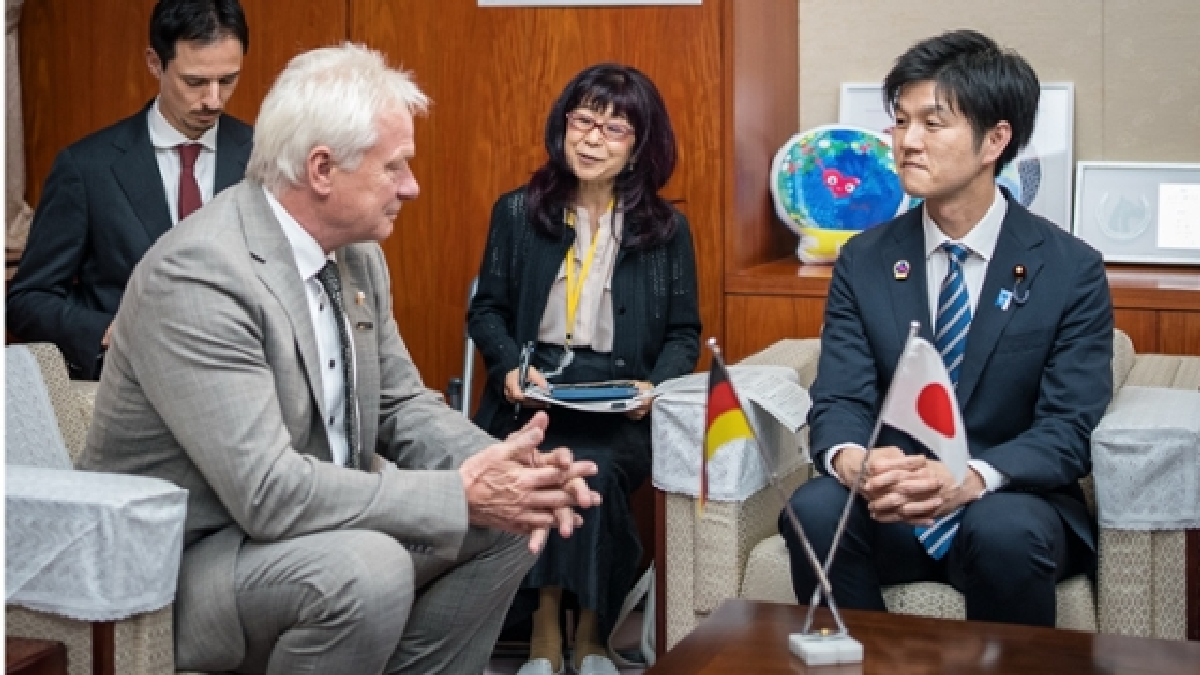
Federal Agriculture Minister Alois Rainer is pushing ahead with the implementation of the agricultural export strategy during his current trip to Asia. A key topic of his discussions in Tokyo was the export of German pork to Japan, which has been suspended since the outbreak of African swine fever (ASF) in Germany.
As the Federal Ministry of Agriculture announced, Germany and Japan intend to further deepen their constructive and trusting cooperation in the agricultural and food sectors. Following bilateral talks, Alois Rainer and his Japanese counterpart, Norikazu Suzuki, signed a corresponding protocol declaration in Tokyo on the very first day of his Asian tour (June 15).
Both ministers agreed in a protocol statement to swiftly continue the scientific exchange on regionalization in light of the African Swine Fever (ASF) outbreak. Experts at the Federal Ministry of Food, Agriculture and Consumer Protection (BMLEH) are already in close contact with Japanese authorities to meet the requirements for exporting heat-treated pork. Minister Rainer emphasized the importance of close relations in times of uncertain markets and pointed out that Japan, with a self-sufficiency rate of only 38%, is an important trading partner.
Following his stay in Japan, the Federal Minister will travel on to China, another crucial market for Germany that has been devastated by African swine fever. There, he will also meet with his counterpart for bilateral talks. The Minister will be accompanied throughout his trip by a large business delegation.
Both China and Japan imposed an import ban on pork from Germany in 2020 due to the spread of African swine fever (ASF). Prior to the ban, approximately 602,000 tons of pork and pork by-products were exported from Germany to China in 2019, and around 39,000 tons to Japan. This made China the first and fifth largest export markets for pork outside the EU, respectively. In 2019, these two countries alone accounted for 57% of Germany’s pork exports to non-EU countries.