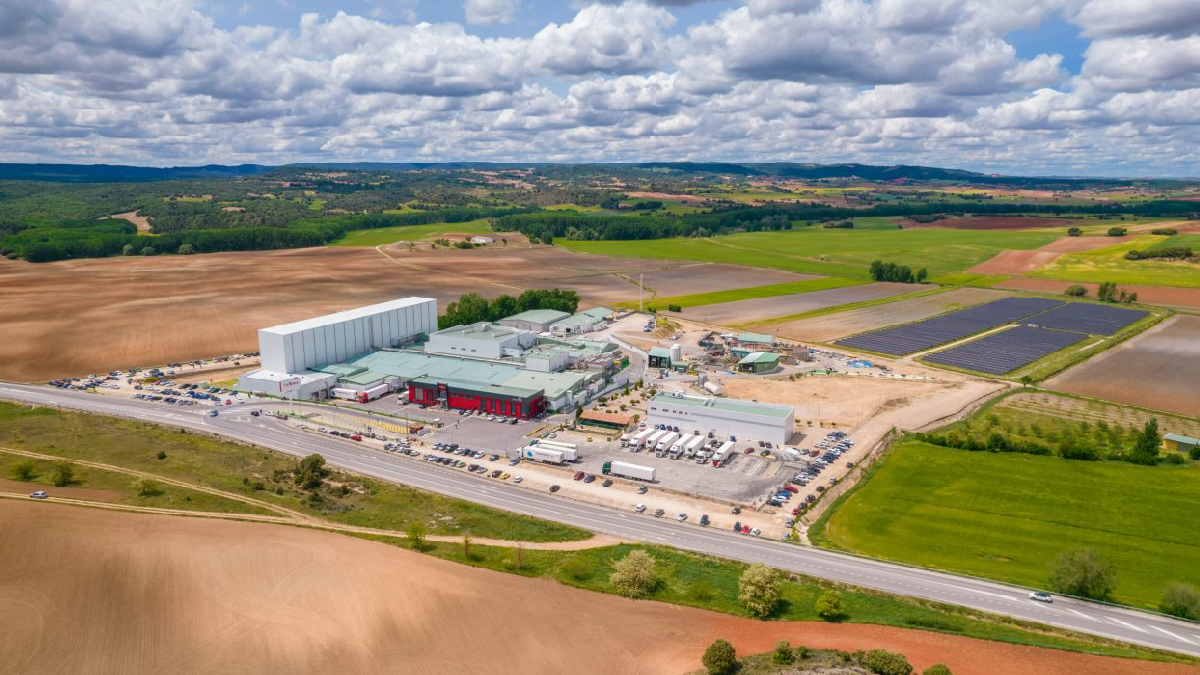
Grupo Vall Companys closed the 2025 fiscal year with a turnover of €4.626 billion, according to its annual accounts filed with the Mercantile Registry. This figure positions it as the leading business group in the food sector in Spain. Grupo Vall Companys, originally from Lleida, has made a strategic commitment to Aragon, and its operations in the region amount to €941 million.
This snapshot highlights the importance of Aragon as a strategic region for the corporation’s operations. Today, Vall Companys Group’s revenue in Aragon represents 20.3% of the Group’s total revenue and translates into a territorial presence of six factories and a distribution warehouse.
Specifically, in Ejea de los Caballeros there is a feed mill and a state-of-the-art pig slaughterhouse (Vall Companys SA and Cárnicas Cinco Villas), a flour mill in Tardienta (Harinas Tardienta), a poultry hatchery in Sástago (Pondex), a tripe and offal processing plant in Mercazaragoza (International Casing Products), and a ham curing facility and marketing company in Calamocha (Jamcal and Comercial Logística Calamocha). The Group generates a total of 2,713 jobs across these six locations, an increase from the previous year.
More investment to maintain leadership
In such a global sector, where Spanish and Aragonese meat production has become a world leader, Grupo Vall Companys invests year after year to maintain its production plants in a leading position. During 2025, the group almost doubled its investment rate in its Aragonese facilities , increasing from €8.2 million the previous year to €14.6 million.
Specifically, in Calamocha a total investment of 5.2 million euros has been disbursed, mainly for slicing machinery and other productive improvements to contribute to the improvement of energy efficiency.
Resources have also been allocated to quality projects in the production process. For example, in 2025 the company acquired a high-pressure machine to maintain its ham exports.
At Cárnicas Cinco Villas , €5 million was invested, and at the International Casing Products facilities in Mercazaragoza, €2.8 million. These investments aimed to improve energy efficiency, competitiveness, and production efficiency with new machinery.
Meanwhile, the Biovall Heparine Science project continues to progress, a joint initiative with Bioibérica for the production of heparin from porcine intestinal mucosa.
Globally, the company’s net margin has fallen to 5.3% of sales to third parties, equivalent to a net profit of €245.4 million, due to global instability, but also because of an unexpected year-end. The declaration of African Swine Fever (ASF) triggered a contingency plan that impacted the 2025 net result.
PPA: market closures, devaluation, and contingency plan
On November 28, 2025, African swine fever (ASF) was declared; signifying a severe and unprecedented blow to the competitiveness of the Spanish pig sector, both in livestock farming and in international meat marketing.
The outbreak of African swine fever that began in Bellaterra led to the complete closure of markets (Japan, Mexico, among others) or partial closures (China and the Philippines, the latter initially completely closed but now subject to regional restrictions) for meat and by-product exports. This situation caused a collapse in the price at the Mercolleida wholesale market, leaving pig farming with production costs far exceeding benchmark values.
Faced with this situation, the Group’s management activated a financial contingency plan that seeks to mitigate the economic and competitiveness crisis caused by the outbreak of SPP and the closure of markets, assuming a highly complex 2026.
In this regard, the company has activated a financial contingency plan in response to the PPA and its commercial consequences. Initially, a provision of €61 million has been made, in accordance with the accounting standard due to the devaluation of livestock inventory; the dividend has been halved, from the projected €72 million to €36 million; and a mandate has been issued to reduce budgeted investments in the Group’s assets for 2026 from €190 million to €85 million; among other actions.
The outbreak of African Swine Fever poses a serious threat to the meat industry, as it devalues the price of pork at the farm level and also partially or completely blocks export markets, some of them high-value. The problem is exacerbated by the fact that it could persist indefinitely if the outbreak is not controlled through culling and eradication of the disease.
International implementation in Latin America
Grupo Vall Companys has always considered that the best way to protect its business and value chain in Spain is through productive diversification on the peninsula (different business avenues and circular economy) and with an international implementation plan that has been developing since 2016.
With the aim of further diversifying production in different parts of the world, expansion in Latin America has accelerated with entry into two new countries. Already in 2026, they have reached agreements with Coexca SA in Chile, through its Brazilian subsidiary Master Agroindustrial, and with Grupo Pacuca in Argentine, securing a $14 million participatory loan.
In addition to these countries, since 2016, the Vall Companys Group has been gradually establishing itself as a minority shareholder in companies in Peru, Colombia, Uruguay, and Brazil, with the exception of Mexico, where it already holds a 75% stake. All operations have focused on creating synergies, contributing know-how, and strengthening the livestock and meat value chain. The criteria guiding the investment decisions were based on the fact that these markets had a domestic production deficit, making it necessary to incentivize local production.
The Group has strengthened its international presence. In recent years, thanks to exports, many local talents have been able to advance professionally, specializing in international trade. Now, this implementation process presents a growth opportunity for many professionals within the Vall Companys Group, including veterinarians, agronomists, finance specialists, human resources professionals, and engineers, among others.
It’s committed to local talent and training
The agri-food group is committed to a proactive approach to attracting and retaining talent. To this end, it has over 200 training agreements with universities and vocational training centers throughout Spain, many of which are located in Aragon.
The company has made continuous training a key strategy for promoting internal talent. Throughout 2025, nearly €1.5 million and over 68,000 hours of training were invested in the Group’s professionals. For this reason, and other employability criteria, the Vall Companys Group has earned the TOP Employer certification for the sixth consecutive year. This certification recognizes the Group as one of the leading employers in Spain.